
Does Journaling Actually Help? An Evidence-Based Look at How Writing Can Support Mental Health
.png)

Through the process of writing down our thoughts, emotions, and experiences, we can expand our capacity for processing and sorting through the fog.
Have you ever felt like your brain might erupt from all the thoughts spiraling around at once? Or perhaps your body might implode from all the competing emotions? Maybe you just have no idea where to even begin untangling your thoughts from your emotions and how to move forward. This is a common human experience, as we are all confronted by the need to navigate our inner worlds. But there are ways in which we can make this navigation a little easier, and that’s where the power of writing comes into play. In this article, we will take a look at how journaling, brain dumping, and mind mapping can help with emotional processing, reducing overwhelm, and gaining the clarity to make decisions that help reduce the turbulence of everyday life.
Why Writing Works
Mental clutter and rumination can be exhausting and overwhelming. When we have too many to-dos, worries or emotions all competing for our attention at once, we tend to avoid, procrastinate, ruminate, or get stuck in mental paralysis. When our cognitive load feels like too much, writing down your thoughts can bring some much needed relief. When we put pen to paper (or fingers to keyboards), we externalize this mental load and it creates some space between us and our thoughts.
This concept of creating space between our thoughts and emotions is often referred to as “thought diffusion” in Cognitive Behavioural Therapy. When we use writing to “diffuse” our thoughts, we create some detachment from our thoughts and emotions which allows us to see things more objectively, move towards acceptance of the things we cannot change, and determine actions that better align with our goals and values for the areas we can act on (Ruini and Mortara, 2022).
By externalizing our mental clutter in this way, we can support ourselves in sorting through and prioritizing our problems, fears, and concerns. We learn how to respond rather than react, become more proactive, shift unhelpful thoughts and behaviours, and practice positive self-talk (University of Rochester Medical Center, n.d.). Evidence also shows us that we not only lower levels of stress, anxiety and rumination, but can even support a more robust immune system (Pennebaker, Kiecolt-Glaser, & Glaser, 1988; Stanton et al., 2008).
It is clear from evidence that writing practices can be a helpful therapeutic tool, offering us relief from the stress and overwhelm of daily life. Not only does it provide relief in the ‘offloading’ of mental clutter, it also works to support the overall processing of our lived experiences and promotes growth, change, and wellbeing.
Journaling vs Brain Dumping vs Mind-Maps: What’s the Difference?
Now that we have identified some of the benefits of writing practices, you may be wondering what types exist and which one might be best for you.
What Is Journaling?
Journaling is an intentional writing practice where you can capture your thoughts, insights, emotions, or experiences over time. It promotes self-awareness and personal growth through reflection, thought diffusion, and emotional processing (Ruini and Mortara, 2022).
It can take several forms:
1. Keeping a diary: Routinely writing about your thoughts, feelings, and experiences in a first person narrative.
2. Gratitude journaling: Writing down aspects of your life that you are grateful for to focus on the positive aspects of your life.
3. Bullet journaling: Focusing on simple entries that note only essential information using as little words as possible.
4. Reflective journaling: Writing about experiences to understand what you learned or how you felt.
5. Creative journaling: Expressing yourself through stories, poems, drawings or other creative forms

What Is a Brain Dump?
A Brain Dump can come in very handy when you’re feeling overwhelmed, scattered or even in ‘analysis paralysis’. It is the act of quickly writing down all your thoughts and worries without organization or structure, and without judgement. It can support mental health by clearing mental clutter, allowing you to feel more focused and calm.
What About Mind-Maps?
Similarly to brain dumps, mind-maps are a tool to gain clarity and help reduce overwhelm. However, unlike the unstructured nature of brain dumps, mind-maps are a visual way of organizing thoughts and feelings that are connected around a central topic. Mind-maps can help you better understand your thoughts and feelings and help you see connections you may have missed when trying to sort it out only in your mind.
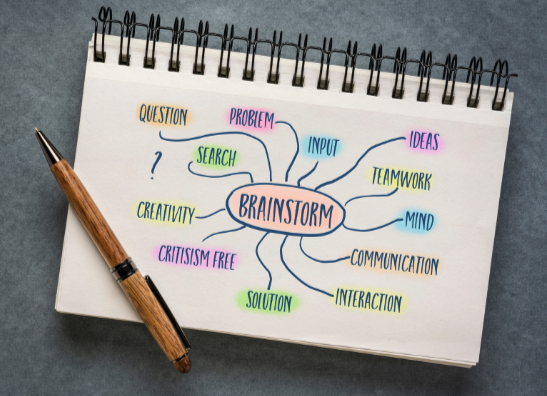
Whatever format of writing you choose, these mental health tools work to facilitate stress management, processing, and clarity. Our minds are incredible machines, but just like all machines, they need mechanisms and systems to support their optimal functioning. Writing, journaling, brain dumping, and mind-maps are excellent ways to externalize some of this work and can be especially helpful for ADHD brains.
How to Get Started (Without Overthinking It)
If you feel like writing out what’s rolling around inside you might be a useful tool to implement in your mental health maintenance, here are some simple ways to begin:
- Set a short time limit to reduce the pressure to ‘perform’. Even a few sentences can reduce overwhelm and shift a mindset.
- Use prompts or lists if you find it hard to get started. Google “Journaling prompts for ____” and input whatever you may be dealing with (anxiety, fear, motivation, etc…).
- Write without editing or judgement – there is no ‘right’ or ‘wrong’ way to journal and grammar and spelling doesn’t matter. Life is messy, journaling can be too.
If you are journaling to simply create mental space and clarity, and you are not tracking patterns or doing reflections later, don’t feel the need to keep your pages if you’re worried about others reading them. It is okay to write and then get rid of them. It’s more important to be honest with yourself while journaling than hold back due to fear of privacy. Let this be your permission to toss your notes as you feel necessary. The act of journaling is more important than the content.
When Writing May Not Feel Helpful—and What to Do Instead
Journaling to support mental health has important limitations to consider. It is not simply the act of putting thoughts on paper. For individuals who feel easily overwhelmed or have difficulty identifying and organizing their thoughts and emotions, journaling can unintentionally intensify distress by reinforcing unhelpful thought loops and magnifying unpleasant emotions. If writing begins to increase distress rather than reduce it, it may be more helpful to pause the practice and shift focus to coping or grounding strategies like box breathing, before returning to reflective writing.
Final Thoughts: Writing as a Supportive Mental Health Practice
In this article we have covered how journaling in many forms can support your mental health. From the evidence available, it is clear that writing out your thoughts, emotions, and experiences helps reduce mental clutter and overwhelm, lessen anxiety, increase self awareness, and promote personal growth. Alongside other types of therapy, journaling is a highly successful therapeutic tool that is easily accessible.
If you’re interested in seeing how journaling can support your mental health, we encourage you to pick up a pen and try it out. Remember there is no right or wrong way to journal. You can choose to write down a few words or a few pages. The goal is to create some mental and emotional space so you can move forward in your healing journey.
If you feel you need further support to sort through your internal dialogue, Cognito’s CBT Care Providers are here to help. Reach out to learn more about how we can integrate journaling into your Cognito mental health sessions.
References:
Pennebaker, J. W., Kiecolt-Glaser, J. K., & Glaser, R. (1988). Disclosure of traumas and immune function: Health implications for psychotherapy. Journal of Consulting and Clinical Psychology, 56(2), 239-245.
Ruini, C., & Mortara, C. C. (2022). Writing Technique Across Psychotherapies-From Traditional Expressive Writing to New Positive Psychology Interventions: A Narrative Review. Journal of contemporary psychotherapy, 52(1), 23–34. https://doi.org/10.1007/s10879-021-09520-9
Stanton, A. L., Danoff-Burg, S., Sworowski, L. A., Collins, C. A., Branstetter, A. D., Rodriguez-Hanley, A., Kirk, S. B., & Austenfeld, J. L. (2008). Randomized, controlled trial of written emotional expression and benefit finding in breast cancer patients. Journal of Clinical Oncology, 26(20), 3358-3365. https://doi.org/10.1200/JCO.2002.08.521
University of Rochester Medical Centre. (n.d.). Journaling for emotional wellness. URMC Health Encyclopedia. Retrieved January 13, 2026, from https://www.urmc.rochester.edu/encyclopedia/content?ContentTypeID=1&ContentID=4552
.png)


.png)


