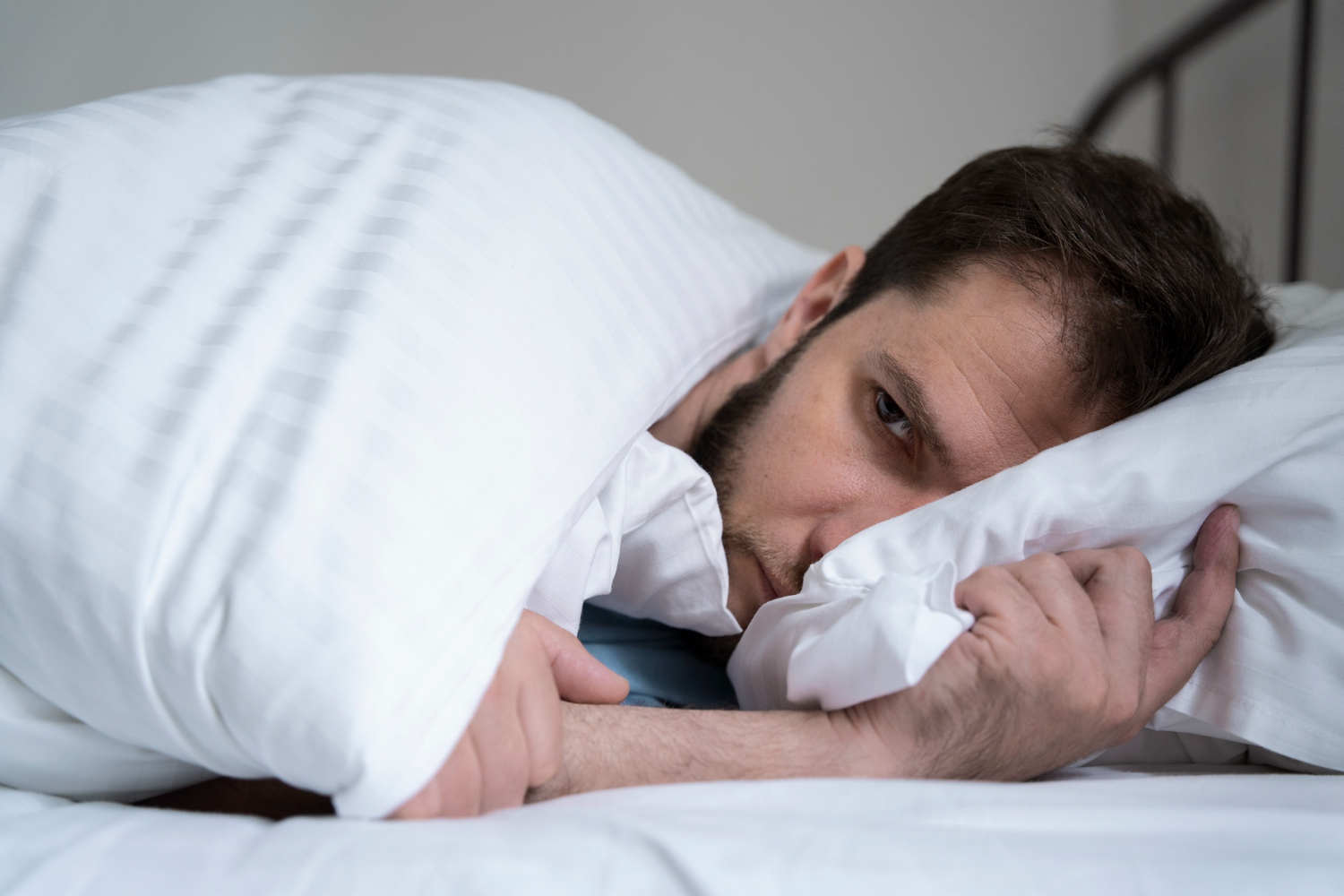
It is 1 a.m., your exam is in eight hours, and your brain will not stop running through everything you have not studied. I see this pattern in students every midterm and finals season. College student insomnia is rarely a willpower problem. It is a stress response doing exactly what it evolved to do, at the worst possible time. Here is why it happens and what you can try tonight.
College Student Insomnia? Why You Can’t Sleep During Midterms and Finals
When I was in university, I spent many nights awake trying to cram in studying for midterms. Since then, I have heard the same story from students, exhausted in the library and wide awake in bed. If you can’t sleep before an exam due to stress, I want you to know that you are not alone and there are practical steps that can help. In this article, we will look at why you can’t sleep when you need it most, what an all-nighter really costs you, and what to try instead.
Why Can’t You Sleep When You’re Stressed About Finals?
Your nervous system has two broad modes. The sympathetic branch prepares you to act quickly, and the parasympathetic branch helps you rest and recover. Harvard Health Publishing (2020) explains that the fight or flight response evolved as a survival mechanism, and that a looming deadline can trigger it just as a physical threat can. When your brain senses a threat, the hypothalamus activates the HPA axis, a network made up of the hypothalamus, the pituitary gland, and the adrenal glands, which releases stress hormones such as adrenaline and cortisol.
From an evolutionary view, falling into a deep sleep was risky when we perceived danger, such as a looming lion attack. The difficulty is that your brain can respond to an unfinished study guide in a similar way, even though no lion is in the room.
Sleep researchers call this hyperarousal, and it is considered a key component of modern models of insomnia. Kalmbach et al. (2018) add that people differ in sleep reactivity, which is the degree to which stress disrupts their sleep. It also explains the tired but wired feeling. Your body is depleted, yet a dramatic video on social media can further activate a brain already on guard.
Why Test Anxiety Gets Louder at Night
Many students manage stress during the day by staying busy. They attend class, run errands, watch a show and scroll on their phones. Distraction can feel like relief, but it also means the worry is never processed. When we finally put our phone down, the thoughts arrive all at once, often as a rush of anxiety about everything that is not done.
Kalmbach et al. (2018) describe how wakeful time in bed is unstructured and often isolated, which gives the mind room for rumination, and how anxious thinking and a stress reactive sleep system can feed each other. Hershner and Chervin (2014) report that about 50% of college students experience daytime sleepiness and roughly 70% get insufficient sleep.
Does an All Nighter Help? What Sleep Deprivation Does to Studying
It is tempting to trade sleep for study time, but the data does not support the trade. Hershner and Chervin (2014) link sleep deprivation in college students to lower grade point averages, compromised learning, and impaired mood. The precise relationship between sleep and memory formation is still being studied, but sleep plays a role in learning.
First you recognize the material. Then you recall it and connect one concept to another. Rereading a textbook for two more hours at midnight mostly exercises the first skill. Many students spend hours in the library but study efficiently for only one or two of them. If efficiency is the goal, protecting sleep usually beats staying up two extra hours.
How to Sleep Before a Big Test When Your Mind Will Not Switch Off
Trying to push a thought away rarely works, and jumping up to study every time it appears keeps the alarm system active.
- Notice the thought for what it is. “I haven’t studied enough” is a thought, not an emergency.
- Ask whether now is the right time to deal with it. If yes, get out of bed and do it. More often, the answer is no.
- If the answer is no, write it on a notepad and schedule time tomorrow to work through it.
Scullin et al. (2018) tested a related idea in 57 healthy young adults. Participants who spent five minutes writing a specific to-do list fell asleep significantly faster than those who wrote about completed tasks. The sample was small and did not include people with insomnia, so the finding may not apply to everyone. One plausible explanation is that writing a worry down signals to the brain that it will be handled later, relieving some pressure on the nervous system.
Read more: Breathing Techniques to Calm the Nervous System
Fixing Your Sleep Schedule During Finals Week
Watson et al. (2015), for the American Academy of Sleep Medicine and Sleep Research Society, recommend that adults sleep 7 or more hours per night on a regular basis, and note that healthy sleep depends on timing and regularity as well as duration. In practice, that means choosing a consistent wake time, working backward to a realistic bedtime, and placing study blocks earlier in the day.
When College Student Insomnia Needs More Than Self Help
Feeling stressed a day or two before a big exam, or even for a week, is a normal part of student life. Concern grows when stress stretches into weeks or months, since it can disrupt falling asleep, staying asleep, and waking refreshed, and it can also affect appetite, motivation to exercise, and mood.
If you feel exhausted most days and it is affecting your life, for example you are missing classes or facing consequences at work, it is time to talk to someone. A family doctor, a counsellor, a campus service, or a trusted friend are all reasonable places to start. For chronic insomnia disorder in adults, the American Academy of Sleep Medicine strongly recommends cognitive behavioural therapy for insomnia as a treatment (Edinger et al., 2021).
Read more: Cognito CBT for Insomnia
My Clinical Takeaway for Students
Stress is not a glitch. It is a survival system doing its job, and a little of it before an exam is normal. My concern starts when the alarm stays on for weeks and sleep stops restoring you.
If sleep trouble becomes a daily problem, I encourage you to seek individualized, evidence based support. General videos cannot be tailored to you. At Cognito Health, we offer CBT for insomnia, anxiety, depression, and ADHD to residents of British Columbia and Ontario, including people who do not have a family doctor.
Tonight, try one small step. Write the thought down, set a wake time, and give yourself permission to rest. If you would like support, you can book a free 15 minute discovery session with our team.
Disclaimer: This post is for education and self-awareness. It is not a diagnosis or replacement for therapy.
References
Edinger, J. D., Arnedt, J. T., Bertisch, S. M., Carney, C. E., Harrington, J. J., Lichstein, K. L., Sateia, M. J., Troxel, W. M., Zhou, E. S., Kazmi, U., Heald, J. L., & Martin, J. L. (2021). Behavioral and psychological treatments for chronic insomnia disorder in adults: An American Academy of Sleep Medicine clinical practice guideline. Journal of Clinical Sleep Medicine, 17(2). https://pmc.ncbi.nlm.nih.gov/articles/PMC7853203/
Harvard Health Publishing. (2020, July 6). Understanding the stress response. Harvard Health. https://www.health.harvard.edu/staying-healthy/understanding-the-stress-response
Hershner, S. D., & Chervin, R. D. (2014). Causes and consequences of sleepiness among college students. Nature and Science of Sleep, 6. https://pmc.ncbi.nlm.nih.gov/articles/PMC4075951/
Kalmbach, D. A., Cuamatzi-Castelan, A. S., Tonnu, C. V., Tran, K. M., Anderson, J. R., Roth, T., & Drake, C. L. (2018). Hyperarousal and sleep reactivity in insomnia: Current insights. Nature and Science of Sleep, 10. https://pmc.ncbi.nlm.nih.gov/articles/PMC6054324/
Scullin, M. K., Krueger, M. L., Ballard, H. K., Pruett, N., & Bliwise, D. L. (2018). The effects of bedtime writing on difficulty falling asleep: A polysomnographic study comparing to-do lists and completed activity lists. Journal of Experimental Psychology: General, 147(1). https://pubmed.ncbi.nlm.nih.gov/29058942/
Watson, N. F., Badr, M. S., Belenky, G., Bliwise, D. L., Buxton, O. M., Buysse, D., Dinges, D. F., Gangwisch, J., Grandner, M. A., Kushida, C., Malhotra, R. K., Martin, J. L., Patel, S. R., Quan, S. F., & Tasali, E. (2015). Recommended amount of sleep for a healthy adult: A joint consensus statement of the American Academy of Sleep Medicine and Sleep Research Society. Sleep, 38(6). https://pmc.ncbi.nlm.nih.gov/articles/PMC4434546/