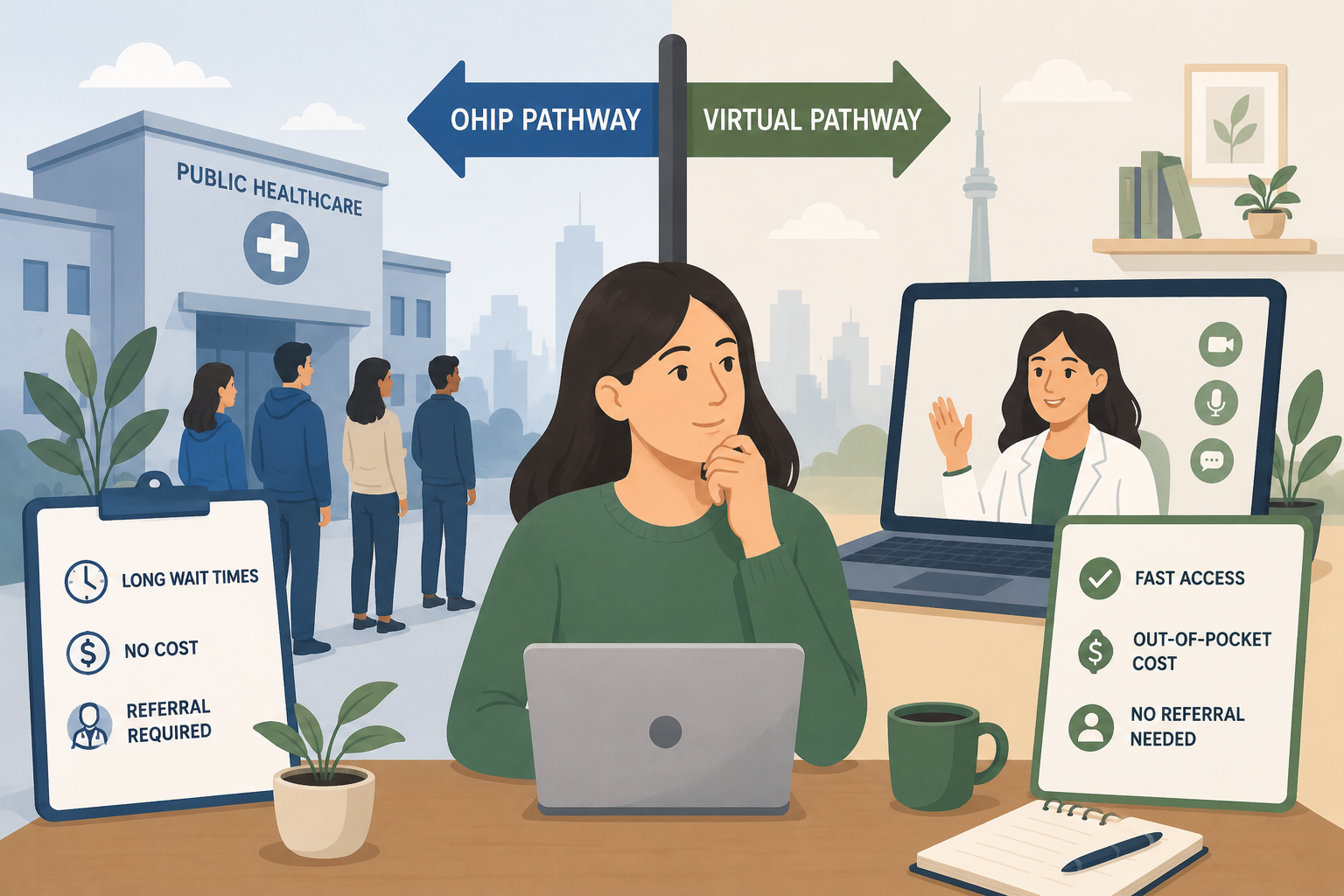
Is It Safe to Use Virtual Clinics for Psychiatric Medications in Canada?
.png)

Are you wondering about the safety of virtual clinics for psychiatric medications in Canada? For many individuals in British Columbia and Ontario, accessing essential mental health care—including treatment for anxiety, depression, and ADHD—is safe and effective when delivered through telehealth services led by licensed practitioners. By adhering to strict clinical standards, secure technology, and psychiatrist oversight, these virtual platforms provide a reliable, convenient pathway to professional psychiatric support.
Is it safe to use virtual clinics for psychiatric medications? Short answer—Yes. For many people in BC and Ontario, it can be safe to receive certain psychiatric medications (like antidepressants, anti‑anxiety medications, stimulants, and sleep medications) through a virtual clinic when care is provided by licensed professionals using evidence‑based practices and secure technology. At Cognito Health, nurse practitioners licensed in BC and ON prescribe medications with psychiatrist oversight, and we follow strict assessment, monitor ing, and safety protocols.
Virtual care is not appropriate for emergencies or some high‑risk situations. However, for mild to moderate ongoing mental health concerns with anxiety, depression, insomnia or ADHD, research shows that telemedicine and virtual mental health services can improve accessibility and effectiveness when delivered within provincial regulations and with proper safety protocols.
What Makes a Virtual Clinic That Prescribes Psychiatric Medications “Safe”?
A virtual mental health clinic is generally considered safe for psychiatric medications when it:
- Uses licensed prescribers such as Nurse Practitioners, registered in the province where you live
- Follows provincial and federal regulations and standards for assessment, prescribing, documentation, and privacy
- Takes a thorough medical history before recommending medication
- Screens for suicide risk, substance use, and medical red flags
- Provides ongoing monitoring and support, not just one‑time prescriptions
- Uses secure, encrypted platforms for video appointments and health records
- Has a clear crisis and escalation plan for higher‑risk situations
If a virtual service skips careful assessment or seems focused on “quick scripts,” that’s a safety concern, regardless of whether it’s online or in person.
How Cognito Health Keeps Psychiatric Medication Use Safe
At Cognito Health, safety is built into how care is delivered in BC and Ontario.
1. Licensed Nurse Practitioners With Psychiatrist Oversight
- Your diagnosis and prescriptions are managed by licensed nurse practitioners (NPs) working within their provincial scope of practice and prescribing authority
- A psychiatrist provides clinical oversight, consultation on complex cases, and support for diagnostic or medication questions
- All prescribing decisions are documented and reviewed according to professional standards
- Your health information is stored in compliance with Canadian privacy laws, including PHIPA in Ontario and BC’s Personal Information Protection Act.
- Our team‑based model means you get accessible NP‑led care with specialist input when needed.
2. Comprehensive Assessment Before Prescribing
Before recommending or adjusting medication, your Nurse Practitioner will:
- Take a detailed mental health history (symptoms, duration, past diagnoses)
- Review previous medications and side effects
- Ask about medical conditions and current medications to reduce interaction risks
- Screen for suicidal thoughts, self‑harm, psychosis, and substance use
- Understand your goals and preferences for treatment
This helps ensure that medications—if used—are appropriate, safe, and tailored to you.
3. Evidence‑Based Prescribing and Monitoring
- Medications are chosen based on clinical guidelines and current evidence, not trends or patient pressure
- Doses are started carefully and adjusted based on your response and side effects
- You’ll have regular follow‑up appointments to check how you’re doing and update your plan
- Where appropriate, your NP can coordinate with your family doctor or other providers (with your consent)
The goal is not just to prescribe, but to ensure you have ongoing care that is tailored to your specific needs.
4. CBT Therapy Alongside Medication
Medication isn’t the only tool we use. Cognitive Behavioural Therapy (CBT) is a highly evidence-based form of psychotherapy we use to support clients with mild to moderate anxiety, depression, insomnia and ADHD.
- Certified CBT therapists provide structured, skills‑based therapy to address thoughts, behaviours, and coping skills
- For many conditions (like depression and anxiety), CBT + medication can be more effective than either alone
- For some people, CBT alone may be enough—your clinician will discuss what fits your needs
Combining therapy and medication improves both outcomes and safety, because therapists also help monitor changes in mood, behaviour, and risk.
5. Privacy, Security, and Technology
- Appointments are held via secure, encrypted video platforms
- Your health information is stored in compliance with Canadian privacy laws and relevant provincial requirements
- We verify your identity and location at the start of care, to ensure we’re practicing within BC/ON rules
- You’ll receive clear information on how to contact your clinician and how your data is used and protected
When Virtual Mental Health Care May Not Be Enough
Even with strong safety standards, there are situations where in‑person care or emergency services are safer, such as:
- Imminent risk of suicide or serious self‑harm
- Acute psychosis, severe agitation, or confusion that makes virtual assessment unreliable
- Situations where you cannot safely participate in a virtual session (e.g., lack of privacy, immediate physical danger)
- Medical emergencies (e.g., overdose, chest pain, serious injury)
In these cases, the safest option is to call 911 or go to your nearest emergency department. Provincial crisis lines in BC and Ontario can also provide 24/7 support.
At Cognito Health, if we identify that your situation is too high‑risk for virtual care alone, we will:
- Explain our concerns clearly
- Provide guidance on the closest appropriate in‑person or emergency services
- Share relevant information with those services, with your consent and within legal requirements, to support a safe transition
Is Online Mental Health Care as Effective as In‑Person Care?
Multiple studies of telemedicine and mental health have found that, for many conditions:
- Virtual care can be as effective as in‑person care for symptom improvement
- Patients often report high satisfaction with the convenience and privacy of virtual appointments
- Continuity of care (showing up consistently) can actually be better when travel and time barriers are removed
Effectiveness depends less on the medium (online vs in‑person) and more on:
- The quality of the clinician
- Adherence to evidence‑based treatment
- Regular follow‑up and monitoring
- A good therapeutic relationship between you and your care team
How to Tell if a Virtual Psychiatric Medication Service Is Safe
Whether you choose Cognito Health or another provider in BC/ON, ask:
- Who will be prescribing my medication?
- Are they a licensed NP, psychiatrist, or physician in my province?
- How do you handle high‑risk situations?
- Do you have clear crisis and escalation protocols?
- What does your assessment process look like?
- Is it thorough, or just a brief questionnaire followed by an automatic prescription?
- Do you offer therapy as well as medication?
- Can I access CBT or other evidence‑based therapies?
- How is my privacy protected?
- What technology is used for video and records, and how is data stored?
A clinic that answers these questions clearly and transparently is more likely to provide safe, trustworthy care.
Common FAQs
1. Can I get ADHD medication through a virtual clinic in BC or Ontario?
In some cases, yes. At Cognito Health, ADHD medications may be prescribed after a thorough assessment by a licensed practitioner in your province, and only when it is clinically appropriate and safe. We review your history, confirm your diagnosis, screen for substance use and medical risks, and provide ongoing follow‑up to ensure you’re on the right medication, at the right dose.
2. How do you decide if I need medication or just therapy?
Your clinician will start with a comprehensive assessment of your symptoms, history, and goals. For some people, CBT alone is appropriate; for others, medication, CBT, or a combination is recommended based on clinical guidelines. We explain the options, make a shared decision with you, and review the plan regularly to see what’s working.
3. What if my situation is too serious for virtual care?
If we identify that your situation is too high‑risk for virtual care alone—for example, if there is imminent risk of suicide, severe psychosis, or a medical emergency—we will explain our concerns, advise you to call 911 or go to the nearest emergency department, and, with your consent, share relevant information to support a safe transition. As well, if your symptoms or situation are outside of our scope of care, our practitioners will always seek oversight by our psychiatrist and if necessary offer to refer you on to a more suitable service.
Conclusion: Safe, Accessible Care is Possible
Virtual clinics offer a safe and effective way to manage psychiatric medications when they prioritize thorough assessments, licensed professionals, and ongoing support. By combining medication management with evidence-based therapy like CBT, Cognito Health provides a comprehensive approach to mental health care that is both accessible and secure for residents of BC and Ontario. If you’re ready to take the next step in your mental health journey, choosing a clinic that values transparency and safety ensures you get the care you deserve from the comfort of your home.
Disclaimer: This post is for education and self-awareness. It is not a diagnosis or replacement for therapy.
Sources
- American Psychiatric Association – Telepsychiatry Toolkit
- CAMH – Cognitive Behavioural Therapy
- BC College of Nurses and Midwives – Registrant Information
- College of Nurses of Ontario – Practice Resources
- Crisis Centre BC – Get Help Now
- ConnexOntario – Mental Health Helpline